A purchasing list can name an inverter while leaving transfer switching and distribution work unassigned. Those omissions become practical questions when separate equipment must be supplied, connected and commissioned.
Evaluating hybrid inverter manufacturers in China through integration begins with that scope of responsibility. A comparison needs to establish which functions arrive together and which remain project tasks before equipment ratings and quoted prices can be interpreted on equivalent terms.
Comparable Ratings Need Comparable Supply Boundaries
Rated power identifies an electrical capability, while a supply schedule identifies equipment and responsibilities. Two offers carrying the same power rating can therefore describe different packages. One may include switching and distribution equipment that another leaves outside its quoted scope, changing the work required to complete the installation.
Delivery scope separates the equipment provided by hybrid inverter manufacturers in China from remaining installation responsibilities. The comparison records included functions, external equipment and interfaces requiring site work. A lower component count becomes meaningful once the omitted or integrated duties have been identified, rather than being treated as a complete description of delivery.
Commissioning responsibilities also need an owner. Factory integration can establish internal connections while the receiving project still supplies battery, source and distribution details. The relevant comparison distinguishes work completed within the product from confirmation of the external installation, with each task attached to the equipment boundary where it occurs.
Integration can change who supplies a function without changing why the function is required. Distribution protection and source switching remain necessary project questions whether they occupy one housing or several. A useful supply comparison follows those responsibilities through the proposed arrangement instead of merely counting separate cabinets.
Four Functions Within an Integrated Inverter
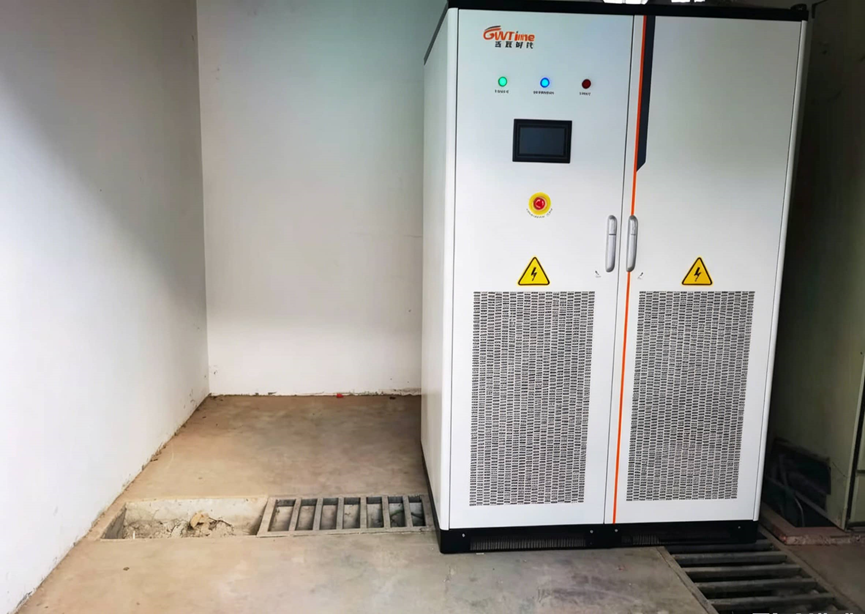
Power conversion, operating coordination, source switching and distribution perform different tasks. PCS handles conversion; EMS coordinates the intended operation; ATS/generator control addresses the source relationship. The distribution board brings associated electrical distribution into the package, giving the assembled unit a broader scope than conversion equipment considered alone.
The location of PV conversion introduces another boundary. External MPPT controllers place PV-side equipment apart from the main inverter enclosure. The supply schedule needs to show that arrangement explicitly, so integration of four functions is not mistaken for inclusion of every device between the solar array and the connected load.
Protection, bypass and auxiliary power equipment also belong in the distribution discussion. Their presence determines which supporting tasks are incorporated into the delivered assembly. The project can then identify remaining connections without assuming that a short product label describes every protection device or operating setting needed at the site.
Testing evidence complements this functional map. A description of manufacturing checks establishes the scope of quality-control work, whereas an equipment specification establishes electrical ratings. Neither should be expanded into an unnamed certification or an unqualified performance guarantee simply because several functions share one enclosure.
A Manufacturing and Integration Reference
GWTime operates a 5,000-square-metre integrated manufacturing facility in Dongguan with automated production lines. Its quality-control testing extends from incoming raw materials to final product dispatch. The factory’s floor area describes facility scale, while quality-control coverage describes which stages are inspected; output volumes and certification credentials require their own separate evidence.
The company’s engineering work covers MPPT, BMS, EMS and storage-system integration, supported by more than 15 years of research and development experience. Project design starts with the load profile, grid behaviour and project economics. Those inputs connect engineering work to the application being discussed rather than to a ranking based solely on factory size.
The GWP125-G01 and GWP250-G01 provide rated outputs of 125 kW and 250 kW respectively in the four-in-one family. PCS, EMS, ATS/generator control and distribution are integrated, while MPPT controllers remain on the PV side. The two power options therefore retain an identifiable functional boundary for comparison with alternative supply arrangements.
Both versions specify a 680-950 V DC full-load range and a 1000 V maximum input. Those different labels distinguish an operating range from an upper limit. The battery interface must be assessed using the relevant operating requirements, rather than accepting the maximum input figure as a complete statement of compatibility.
Assigning the Remaining Project Interfaces
Battery communications, external PV equipment and the receiving distribution remain identifiable project interfaces after internal functions have been combined. The final scope needs to state who supplies their details and who confirms the resulting relationship. A shared enclosure can settle internal procurement while leaving these external responsibilities visible.
GWTime provides the external battery interface through provisions for third-party BMS and battery systems. Their use belongs to the proposed equipment combination. Comparing hybrid inverter manufacturers in China consequently includes how that battery boundary is addressed, alongside the functions delivered inside the inverter package.
External MPPT placement in the GWTime DC-coupled architecture separates PV-conversion heat from the main inverter. The supply schedule records those external controllers and their connections alongside the delivered inverter assembly. The controllers’ PV-side location belongs in the installation layout, where cable routes and service access are identified.
A complete procurement comparison accounts for conversion, control, switching, distribution and the external interfaces still requiring confirmation. Each responsibility has a location in the proposed delivery. Reading that scope before comparing price and rated power establishes what the project is actually purchasing and what work remains to make the equipment operational.